
Portugal’s accession strengthens EU-SOLARIS ERIC
At the beginning of this year, EU-SOLARIS ERIC reached an important milestone in its growth and consolidation as a leading European research infrastructure in Concentrated Solar Technologies (CST):
 Portugal officially joined the consortium as a Member State.
This accession marks a significant step forward in strengthening the consortium’s pan-European dimension and reinforces its mission to establish and operate a world-class distributed research infrastructure dedicated to advancing CST and accelerating the clean energy transition.
With Spain, France, Germany, and Cyprus as current members — and Greece participating as an observer — Portugal’s incorporation expands the consortium’s collaborative network, research capacity, and strategic reach across Europe.
Importantly, Portugal’s accession follows a two-year period of participation as an observer, during which Portuguese institutions actively engaged with the consortium’s activities, contributed to strategic discussions, and strengthened scientific and technical collaboration with existing members. This progression from observer to full member reflects both the value of long-term cooperation and the growing commitment to solar thermal innovation in Europe.
What motivated the decision to join the consortium at this time?
Stemming from SOL4R core competencies in solar concentrating optics by the time of its inception at the University of Évora in 2010, at the time under the designation “Renewable Energies Chair”, the University has participated in the venture of creating what would become EU-SOLARIS from its beginning, having participated in the project standing for its Preparatory Phase, along the period 2012-2016.
Upon the CE Implementing Decision, in 2022, and the constitution of th ERIC in 2023, the University of Évora supported the participation of Portugal as an Observer member as one of the key strategic assets of the portuguese National Research Infrastructure in Concentrated Solar Energy, participated by LNEG, IP and coordinated by the University since its inception, in 2017.
Our coordination of the recently concluded Horizon Europe Twinning project SALTOpower (Grant agreement ID: 10107930, https://doi.org/10.3030/101079303) has set, in the meanwhile, the full membership of Portugal to the ERIC has one of the major scientific alignment objectives. Along the project, not only a deepend relation with EU-SOLARIS members unfolded, here with a special mention to DLR as of its cooperation in the development and operation of our molten salt facilities, but also engagement with national actors in related R&D and industrial fields enabled the due support to our request for full membership adhesion of Portugal, finally approved last December.
What opportunities do you believe this membership opens up for national and European research?
The joint and coordinated effort provided by the ERIC in the development of relevant research infrastructures, in the european space, and on their outreach and engagement with the european R&D, industry and policy actors enables EU-SOLARIS members not only to share resources and to have a common vision for these infrastructures, but also to foster their use as a driver for innovation and for the attainment of European objectives of Industrial leadership in EU-SOLARIS technological fields.
What scientific or technological strengths does your country bring to the ERIC?
Portugal has long been participating in R&D activities in the solar concentration field, with activities in the development of non-imaging optics dating from the 1980’s, at LNEG (INETI, at the time). Having missed the deployment of CSP in Europe, in the 2000’s, Portugal has launched a CSP demonstration programme in 2009, aiming at the installation of small scale pilots – in the range of 5 MWe – of different CSP technologies upon a feed-in tariff scheme. Despite the interest this programme gathered among the CSP industry, with more than 30 applications culminating in 10 selected projects, the program has not been deployed as of the coincidence with the financial crisis of 2008 and ensuing austerity measures imposed in the country.
Notwithstanding, the initiation in 2009 of the HPS project by a German Consortium led by SIEMENS aiming at the demonstration, at a MW scale, of a full fledged molten salt CSP solar field in Évora, stood for a flagship activity, in the country and in this field. The demise of the original Consortium from the project, in 2012, and its rearrangement under the leadership of DLR and acquisition and ownership of the facility by the University of Évora, enabled the resumption of this project in 2015 under the designation HPS2.
In parallel, the University of Évora was leading, at the time, a joint effort with LNEG IP for the creation of a national research infrastructure on concentrated solar energy, gathering the competencies of both institutions in materials science, optics and thermodynamics with pre-existing infrastructural assets in this field. In 2017 INIESC – the National Research Infrastructure on Solar Energy Concentration got its funding upon its inclusion in the first National Roadmap of Research Infrastructures of Strategic Interest, supporting the University participation and joint funding of the HPS2 project.
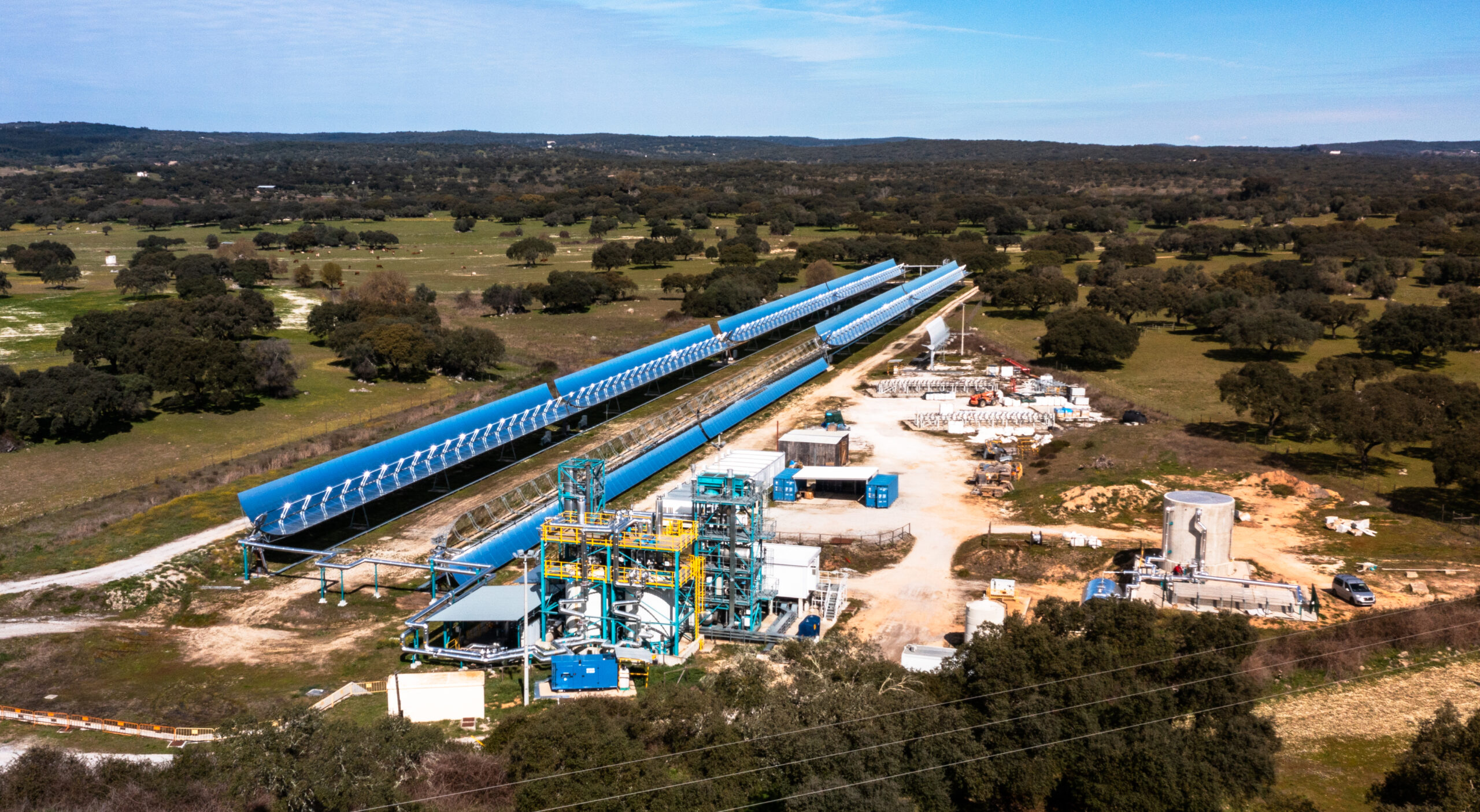
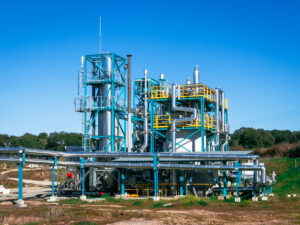
As so, and besides its continued know how and activity in solar concentrating optics and their manifold applications in process heat, desalination or thermochemistry, with the inauguration in 2022 of Évora Molten Salt Platform and of its HPS2 molten salt loop, Portugal could bring to the ERIC EU-SOLARIS the first MW scale solar field operated with molten salts, opening space not only to the industrial demonstration and development of what is becoming the CSP standard – the use of molten salts in the solar field, now also attainable in line-fous systems – but the further use of molten salt storage as an energy hub, enabling large scale energy storage through e.g. Carnot Battery concepts or sector coupling approaches with integration of solar thermochemistry with molten salt driven thermal supply.
How important is European and international cooperation in your field of research?
Whereas European leadership in CSP technologies provides already a strong incentive for European cooperation in this field, their dependence on DNI solar resource further incentives cooperation outside the european space, in view of the more competitive conditions for the deployment of these technologies in countries as e.g. Chile, Australia, South Africa or the MENA region.
Moreover, the emergence of visible supply chain constraints and the potential of CSP related technologies on both power production and energy storage as alternatives to the incumbent tandem PV-Li-ion batteries currently dominating the RE investment landscape, provide further incentives to both European and international cooperation in the pursuit of new strategies assuring the now more visibly important objectives of industrial leadership and security of both technology and energy supply.
How do you think this collaboration will benefit the next generation of researchers in your country?
Providing not only a wider visibility to the technologies supported in the ERIC but also access to European level research infrastructure and world class networking in this scientific field at bth R&D and Industry levels, this collaboration will provide the next generation of researchers not only with improved conditions for research in this scientific field, but also with a coordinated strategy and shared vision on the use of resources, at European level, in support of their career development.